Grotesque and Sublime
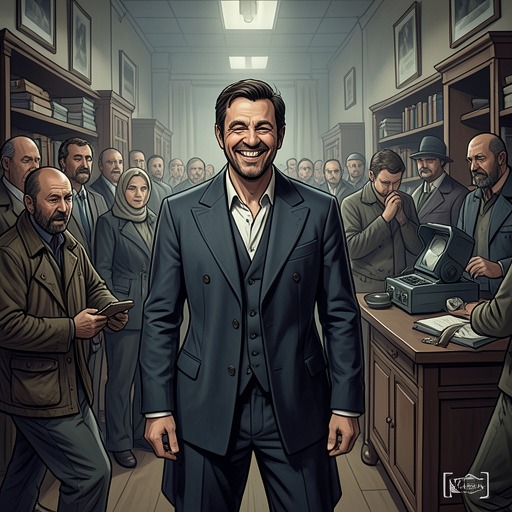
The Man Who LaughsGrotesque and Sublime describes a central reversal in the novel’s treatment of appearance: what society sees as grotesque can also disclose suffering, scale, and moral force. Gwynplaine’s fixed smile is made into public entertainment, but the narrative and the Duchess recast it as a sign of imposed harm and a challenge to those who mistake social approval for justice.
The fixed face and divided self
Gwynplaine’s altered face presents the grotesque as an outward expression that does not match the person beneath it. The narrator describes a face that makes observers laugh, while stressing that the laughter belongs to the face rather than to Gwynplaine’s thoughts. Its expression is involuntary and permanent; his inner feelings cannot alter it. The contrast between a body otherwise described as tall, well-made, and agile and a face that provokes sharply different responses concentrates attention on how one visible feature can govern the reading of an entire person.
The account leaves the cause of the expression partly uncertain, attributing it to chance or to deliberate work and associating it with Gwynplaine’s infancy. That uncertainty matters to the concept: the face looks like an absurd or monstrous spectacle, yet it is also evidence of an imposed past. Its public meaning—laughter—conceals a private reality that the expression itself cannot communicate.
The social production of spectacle
Gwynplaine’s face organizes encounters around a repeated sequence: people laugh when they see him, then turn away; women in particular are described as recoiling after the novelty has passed. The response makes his appearance both a means of drawing attention and a basis for exclusion. The grotesque is therefore not simply a quality of his features. It is produced in the gap between his involuntary expression and the meanings other people attach to it.
The Duchess offers a strikingly different interpretation. She treats Gwynplaine as a mirror that reveals something about her own nature, and she calls herself monstrous through comparison with him. Her language raises deformity above ordinary ugliness, associating it with a reversed or hidden aspect of sublimity. In this account, the sublime is not conventional beauty: it is an overwhelming grandeur encountered in what polite judgment would reject. Her response does not erase the power imbalance between them; admiration, desire, and a commanding manner remain entangled. Instead, her changed reading exposes how unstable the boundary between repulsion and exaltation can be.
From individual appearance to political figure
When Gwynplaine addresses the Lords, he interprets his face as more than a personal condition. He presents its fixed laugh as the result of royal power and connects it with enforced silence, anger, and despair. He then enlarges the meaning: the altered face becomes an image of a humanity whose reason, justice, and truth have also been deformed by its masters. The grotesque becomes political testimony because the spectacle that once invited laughter is made to accuse its audience.
This shift gives the grotesque and the sublime a shared political force. Gwynplaine is treated as an exception because he looks unlike other people; in his speech, he reverses that judgment, presenting himself as representative and the powerful as the true exception. His visible difference becomes a means of speaking about widespread suffering. The grand scale of that claim does not make his experience less particular: its force depends on the contradiction between the suffering individual and the symbol imposed upon him.
The sublime beyond the human body
Elsewhere, the narrative gives the sublime a natural and metaphysical scale. The hurricane is rendered as a cosmic cry beyond ordinary speech, while the sea alternates between violence and deceptive calm. Shipwreck, in turn, is defined through helplessness: people remain near land yet cannot reach it, caught between sky, water, and the limits of their own power. These scenes extend the concept beyond bodily appearance. The sublime emerges wherever human understanding and control confront forces that seem immense, indifferent, and difficult to interpret.
The image of an unburied dead man similarly makes a physical remnant into a sign that prompts speculation about justice beyond human law. Across these different cases, the narrative joins visible matter to an invisible meaning: a face, a body, a storm, or a wreck can become evidence of forces larger than itself. Gwynplaine’s face is the most concentrated instance of that pattern, at once an object of public spectacle and a testimony about the power that shaped it.